 Binaryx
 secondary market
Binaryx’s spot market matches buyers and sellers of shares in fully funded properties that are generating rent. A sell order needs a matching buyer at an allowed price, so it can remain unsold even after it is accepted.
- Trading prerequisites
- Completed identity verification (KYC), with property shares to sell or USDT to buy. Binaryx excludes US citizens and residents of restricted jurisdictions.
- Quoted price
- USDT per property share.
Why can an accepted sell order keep waiting?
A limit order sets a price and can wait up to 90 days in the order book for a counterparty. If it expires, the reserved balance is released. A market sell order trades against bids already in the book, potentially across several price levels; it never waits in the book for new buyers. Neither order type creates buyer demand or guarantees a sale deadline.
Rental performance, yields available elsewhere, changes in the building’s valuation, and demand for liquidity can affect what buyers will pay. The property’s appraisal does not commit another investor to buying shares at that value.


Which price limits can prevent execution?
An order’s price must stay within 10% above or below the current reference price. Before a property’s market has traded, that reference comes from its appraised value per share. After trading begins, the reference re-anchors to the last traded price about once a minute. Repeated trades can therefore move prices more than 10% away from the original appraisal as the permitted range moves with the reference.
An incoming order outside the permitted range is rejected immediately. A resting limit order keeps its chosen price as the reference changes. If matching reaches that order while its price is outside the permitted range, the order is cancelled and reserved funds return to the balance.
Hypothetical example: Why does a sell order fail its price check?
Assume a hypothetical verified seller holds shares in a fully funded property that is generating rent. All prices in this example are hypothetical: the current reference is 48 USDT per share, and the seller’s limit price is 54 USDT per share.
The documented 10% price corridor gives a lower bound of 48 × 0.90 = 43.20 USDT per share and an upper bound of 48 × 1.10 = 52.80 USDT per share. The 54 USDT sell order exceeds that upper bound, so it is rejected before matching.
Reducing the hypothetical sell limit to 52 USDT per share would satisfy this price check. The order would still need a matching buyer to execute. A different reference price would change both bounds of the permitted range.
Which fees apply when an order fills?
For order-book spot trading, Binaryx lists a 2% maker fee and a 3% taker fee. The maker provides an order that rests in the book and is filled by someone else; the taker fills an order already in the book. Either the buyer or the seller can occupy either role. The settlement transaction also has a network fee, separate from Binaryx’s trading charge.
Binaryx’s fee FAQ describes a different P2P seller-side total of 5% of the sale amount, consisting of a 3% discount for the buyer and a 2% transaction charge. That total concerns the P2P sale mechanism described in the FAQ; the spot order-book documentation uses maker and taker fees.
What can hold up a construction-token exit?
The construction Investment Strategies process uses priority and standard sale pools. Priority Sale carries a 5% sales fee, and the standard pool sells only after the priority pool has been fully bought. Sales depend on buyers purchasing the pooled tokens, so priority does not establish a fixed completion time.
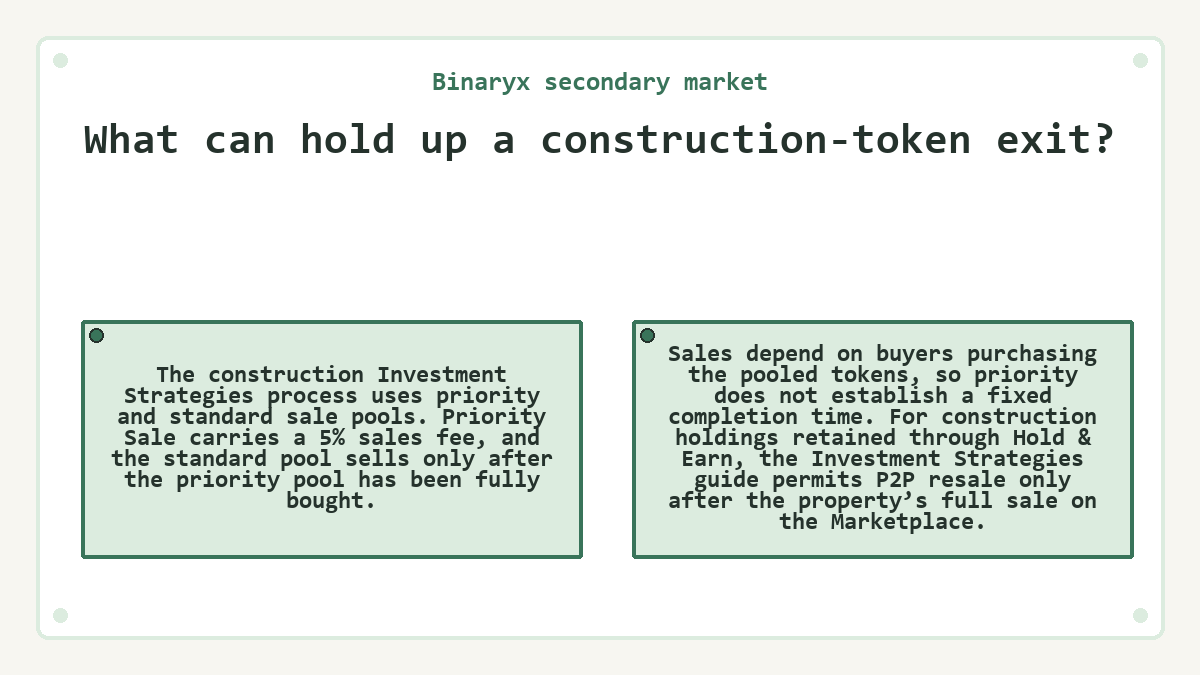
For construction holdings retained through Hold & Earn, the Investment Strategies guide permits P2P resale only after the property’s full sale on the Marketplace.
How does settlement differ from placing an order?
After orders match, a smart contract exchanges the property shares and USDT payment together in one on-chain transaction. An order’s submission, appearance in the book, or match does not, on its own, confirm that transfer. Pending means settlement is underway; Completed means it is confirmed on-chain. If settlement fails, the matched trade is undone and the reserved balance is released.
Updated on